How Not to Peak

Gracie Abrams just dropped a new album last week, Daughter From Hell. It’s really good. So of course Gracie is everywhere all at once.
But one interview caught me off guard.
Her producer said, “I don’t know if we’ll ever make a good song again.” And Gracie’s nodding along saying “It’s over.”
She’s 26. Wtf. She’s already worried her best is behind her. That she’s peaked.
But then I realize Look At My Life, a song on this album, sings:
How long have I got. In the hot light till the shine rusts? But oh well, look at my life
In a CBS interview asking about this, Gracie says:
There’s always the next girl, there’s always the next shiny object, there’s always the next great show. My hope is longevity, not like white-hot moment, you know?
Interesting. I mean, I’m 48. You can forgive me for worrying about stuff like this. But a 26 year old?
But here’s the thing. This isn’t a story about Gracie Abrams. It’s about the 50 year old sitting right next to her.
If you look at 49 million scientific papers written by 3 million scientists over more than a century, do you see any interesting patterns? For sure :)
That’s what a team from the University of Pittsburgh and the University of Arizona did recently. They’ve published a preprint of their research. It hasn’t been peer reviewed yet, but the results are fascinating if they hold up. They looked at field exploration over a career. Here are two scientists in their dataset, Herbert Simon and Giovanni Abbiendi.
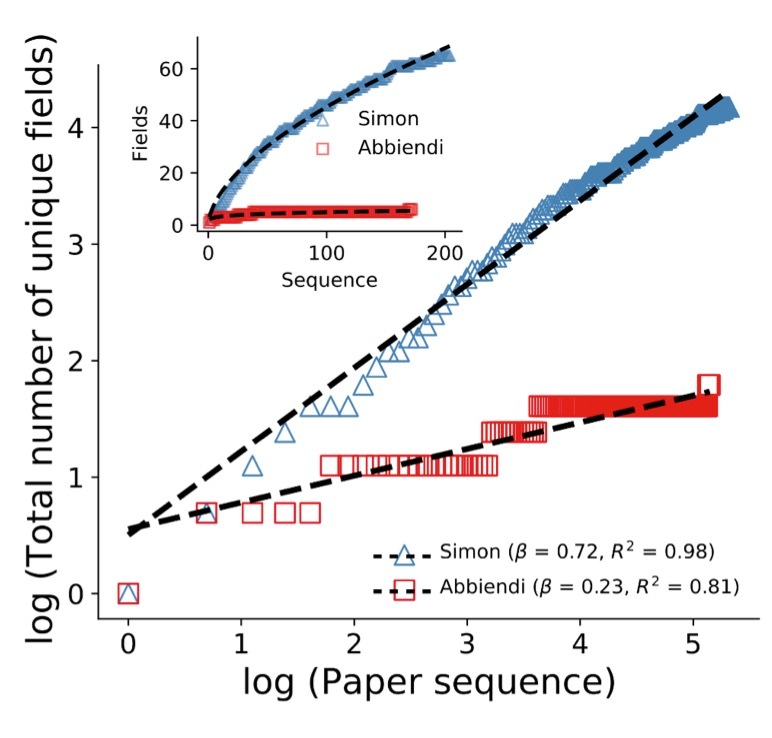
Abbiendi in red, sticks to his chosen field, Particle Physics, over the course of paper after paper during his 40 year career.
But Simon? Simon is all over the place. In this graph you can see:
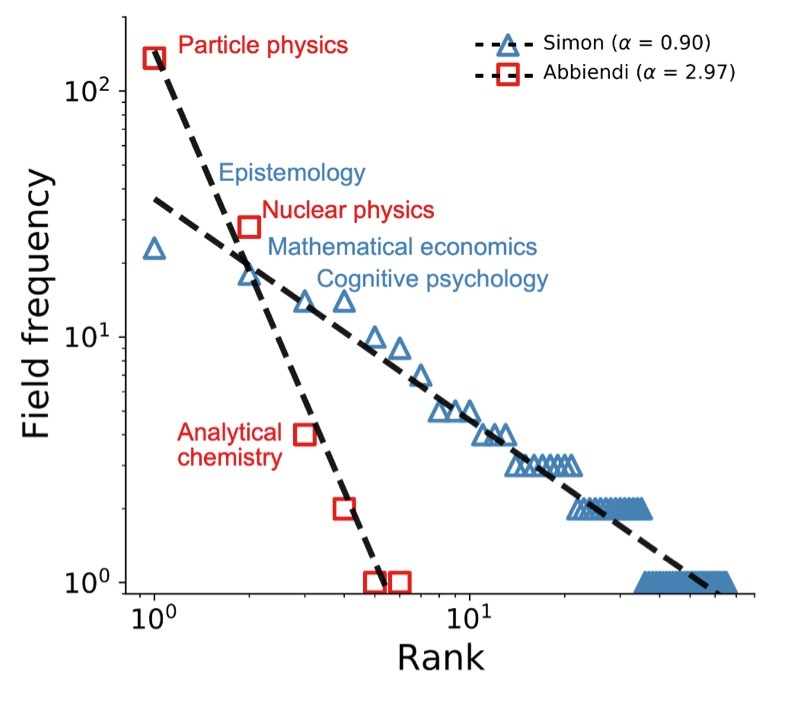
Simon is just as likely to be talking about psychology or math or economics or AI. He’s got a Nobel Prize in economics AND a Turing Award (that’s like a Nobel for computer science.)
Abbiendi? Particle Physics of course. Sure for fun throw in a little Nuclear Physics. :)
Abbiendi looks like a specialist. Simon’s a generalist. Who cares?
That’s where it gets interesting. The team sorted the scientists into four groups, from the most specialized to the most generalist.
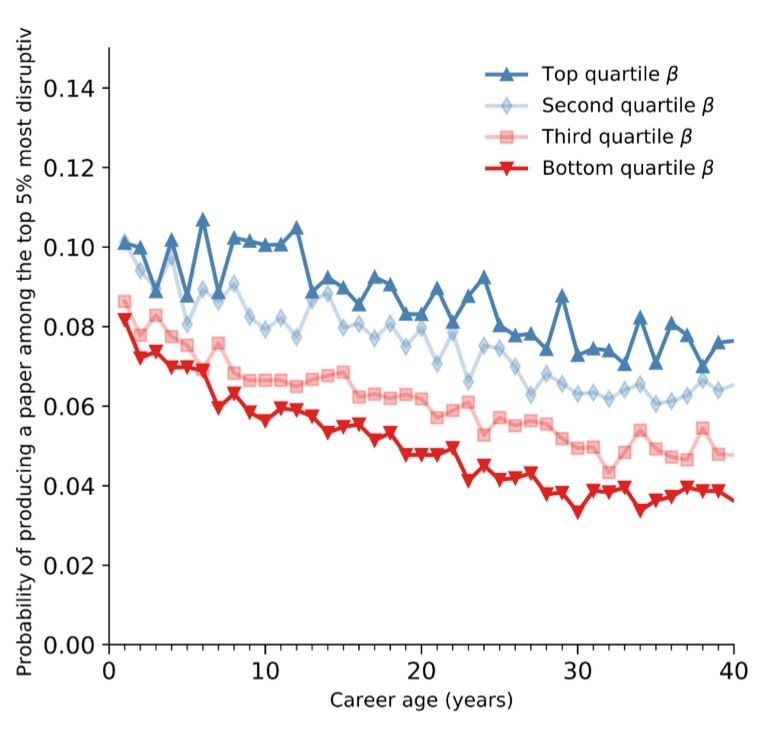
The strong generalist outperforms the specialists at almost every single point of their careers when it comes to disruption. (Disruption here means later papers cite this new work without continuing to cite as much of the older work it was built on.)
The impact is especially strong 40 years in when the strongest generalists are outperforming the most specialized specialists with double the chance of having a very disruptive paper published.
Let that sink in a second. Forty years into their careers, the strongest generalists are even out disrupting the youngest hot shot new specialists.
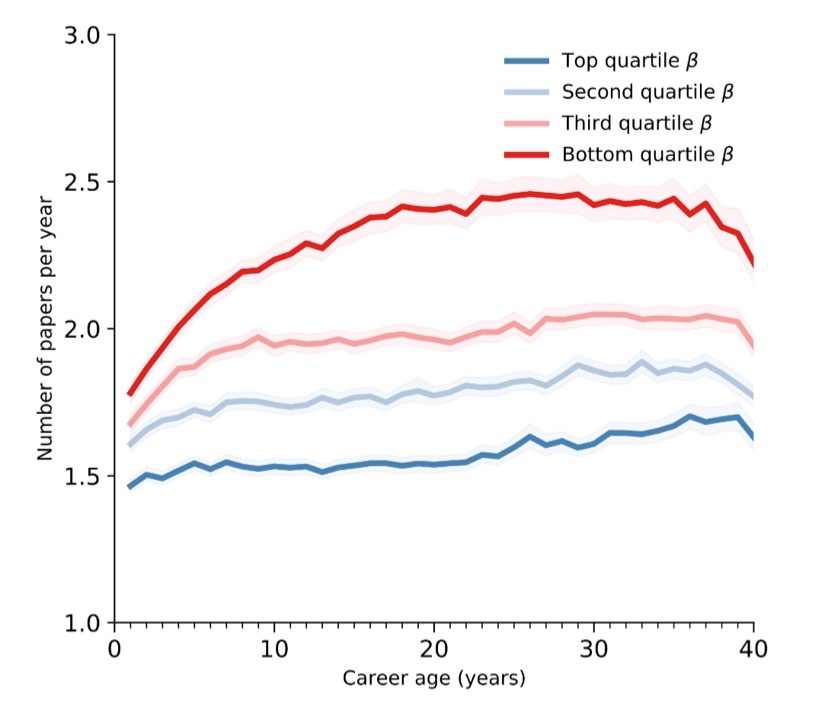
Ok, but you could argue: well maybe the generalists are just pushing out more and more papers about more and more things? Giving them even more chances for this success?
Nope. Generalists are in fact publishing fewer papers than their specialist peers.
They also found just stuffing more fields into a paper wasn’t it either. The more fields referenced in a paper, the worse its chances of being highly disruptive were.
So what is it? The research team:
These findings suggest that the advantage of generalists arises not simply from broad experience across fields, but from their ability to continually renew the intellectual foundations of their work.
Maybe longevity really depends on being willing to start over again.
The paper made me think again about the 50-year-old sitting next to Gracie.
He sure looked familiar. Oh yeah! I saw him during the pandemic. He was playing piano for Taylor Swift in the folklore film that came out, The Long Pond Studio Sessions.
That guy is Aaron Dessner. And if you look him up, he’s behind a lot more than backing piano for Swift. He co-wrote or produced 11 of folklore’s 16 original tracks. Was even more central to evermore. And he’s gone on to write with Ed Sheeran, Brandi Carlile, Mumford & Sons, Noah Kahan. Jesus this list goes on and on.
And of course Gracie. Not just like, produced a song here and there. He’s been a major co-architect of the music Gracie has made over the last six years.
Aaron reminds me of one of those generalist scientists.
I had almost forgotten Aaron was a founding member of The National. A fantastic band in their own right. But they were formed in 1999. Gracie Abrams was born in 1999. So I doubt many folks watching a Gracie show or interview have even heard of The National let alone recognize Aaron from that band.
And now Aaron keeps finding his way into the center of the current music conversation at 50. Not because of The National. But because Aaron generalized what kind of musician he was allowed to be.
Of course, staying relevant isn’t easy. Aaron in an interview with The Creative Independent:
I also think that no matter how many songs you’ve made, or how many records you’ve made, each time you start again, it feels like you’ve never made any.
Like those generalist scientists, Aaron is constantly putting himself back into beginner’s mind territory. New artists. New roles. New genres. Maybe all that newness keeps him nimble. Or at least keeps him practiced at being a beginner.
Aaron, clearly like the rest of us, may not feel like he knows how to stay relevant year after year. But his career sure looks like he’s figured something out.
And Gracie’s worried about staying relevant? She picked the perfect role model to sit next to.